This essay is adapted from my Turkish-language CultPost podcast episode, first released in June 2023. It has been translated and edited for international readers while preserving the original argument, examples, and critical perspective.
Spoiler warning: This essay discusses major plot developments.
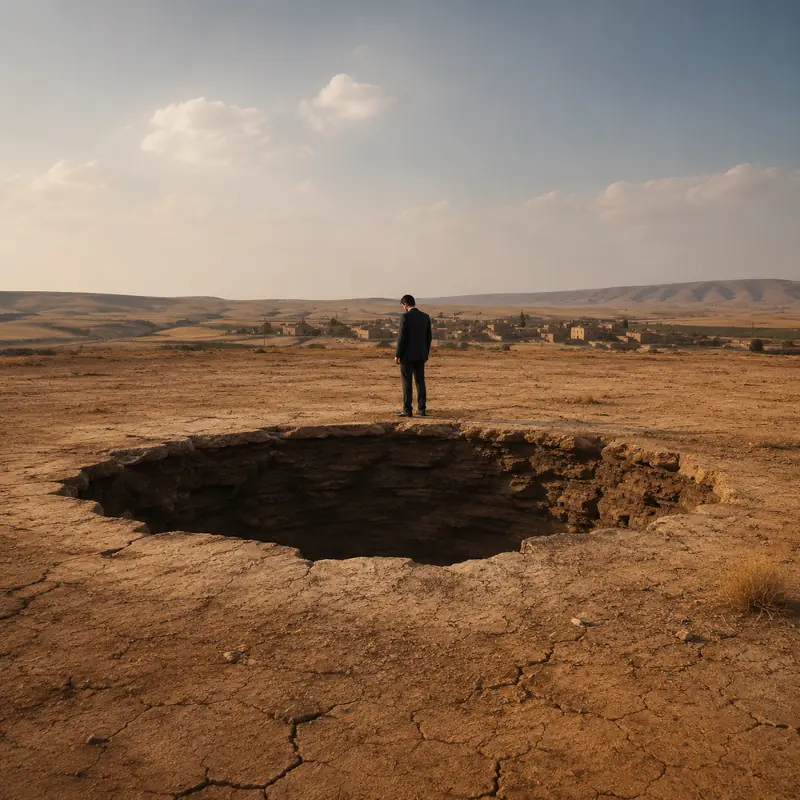
Emin Alper’s Burning Days (Kurak Günler, 2022), which premiered in the Un Certain Regard section of the 2022 Cannes Film Festival, is a tense political thriller set in Yanıklar, a fictional town in Central Anatolia. Emre, a young and inexperienced public prosecutor, arrives from Ankara as the town confronts a severe water shortage and the appearance of enormous sinkholes. He soon encounters an entrenched network of local power centered on Mayor Selim, his son Şahin, and the public institutions that protect them. Murat, the owner of the local newspaper, attempts to expose the municipality’s role in the ecological crisis and encourages Emre to investigate.
The film has understandably been read as a critique of corruption, authoritarian populism, homophobia, and patriarchal violence in contemporary Turkey. Yanıklar appears as a political microcosm in which environmental destruction, electoral manipulation, sexual violence, and institutional complicity reinforce one another. My concern is not that these criticisms are false. Rather, it is that the film concentrates them so completely in provincial space that “the provinces” risk becoming a malevolent Other: the place onto which metropolitan culture projects the violence, irrationality, and corruption of the nation.
This representational problem becomes clearer when Burning Days is considered through the center–periphery distinction developed by the Turkish sociologist Şerif Mardin. The framework helps illuminate the film’s political allegory, but it also reveals the limits of its gaze.
Yanıklar as a Landscape of Violence
From its opening scenes, Burning Days presents Yanıklar as a place governed by its own codes. Emre witnesses men chasing a wild boar through the streets before shooting it and dragging its body through the town. His objection—that firearms cannot legally be discharged in a residential area—is met with the suggestion that this is simply a local custom. The encounter immediately establishes a conflict between the abstract authority of law and a masculine communal order that claims exemption from it.
The town’s ecological crisis deepens this conflict. The municipality promises to bring water to Yanıklar, but its extraction of groundwater is linked to the sinkholes threatening the region. Scientific evidence has been suppressed, a court has suspended the project, and the mayor seeks a way around the ruling as an election approaches. Water is distributed through tanker trucks in a highly visible performance of municipal generosity. A shared resource becomes an instrument of political dependency: the authority responsible for the crisis presents itself as the population’s only possible savior.
Emre initially appears to stand outside this system. He is young, educated, secular, and committed to legal procedure. Yet the film quickly destabilizes his moral distance. After accepting an invitation to dinner at Şahin’s home, he drinks heavily and loses his memory of the night. The following day, he learns that Pekmez, a young Romani woman who had been brought to the gathering, has been sexually assaulted. As his recollections return only in fragments, Emre cannot be certain whether he was merely present or personally implicated. The prosecutor who has arrived to investigate the town is drawn into its structure of guilt.
The two main crises—the destructive water project and the assault on Pekmez—therefore become parallel expressions of the same political culture. Bodies and natural resources are treated as available for exploitation, while institutions that should provide accountability instead protect local power. The police resist Emre’s investigation, the judge pressures him to release Şahin, and the townspeople are mobilized against anyone who threatens the established order. Homophobic rumors about Emre’s relationship with Murat become an especially effective political weapon.
Through these elements, Yanıklar is constructed as a closed world marked by patriarchy, ethnic marginalization, homophobia, ecological plunder, and nationalist-militarist violence. The film’s critique is powerful, and many of its observations are recognizable within contemporary Turkey. The difficulty is that these pathologies appear to belong almost organically to the provincial setting. Yanıklar is not only where violence occurs; the town itself comes to signify violence.
The Center–Periphery Divide in Turkey
In Turkish, taşra means more than the countryside. It refers to places outside the major political and cultural centers, but it also names a social condition associated with distance from metropolitan life, limited cultural capital, conservatism, and an allegedly incomplete experience of modernity. The term is therefore geographic, political, and symbolic at once.
Şerif Mardin’s influential 1973 essay “Center-Periphery Relations: A Key to Turkish Politics” traced this division from the late Ottoman Empire into the Turkish Republic. In simplified terms, the center consisted of the bureaucratic and military institutions that directed state-led modernization. Under the Republic, it became associated with a Westernizing, secular, and Turkish nationalist elite. The periphery included religious, regional, and ethnic groups that remained outside this administrative core or resisted its attempts at cultural transformation.
The Republican center did not simply abandon the provinces. It treated them paternalistically as spaces that had not yet been reached by modernization. Early Republican literature repeatedly staged this relationship through educated characters traveling from the city to Anatolia. In novels such as Yakup Kadri Karaosmanoğlu’s Yaban (The Stranger) and Reşat Nuri Güntekin’s Çalıkuşu (The Wren), teachers and intellectuals confront the distance between the modernizing ideals of the Republic and provincial life. The province appears as both an obstacle and an object of reform.
The same opposition shaped electoral politics after Turkey’s transition to a multiparty system. The Republican People’s Party (CHP) remained closely associated with the state center, while the Democrat Party mobilized provincial, religious, and commercial groups that felt excluded from it. Mardin’s model has since been used to interpret many later political conflicts, even though the identities and locations of “center” and “periphery” have changed considerably.
Burning Days reactivates this national allegory. Emre arrives from Ankara bearing the authority of the secular, legal-rational state. The mayor and his circle represent a provincial conservative elite that converts local solidarity, religious morality, and promises of development into electoral power. Murat, with his oppositional newspaper and his status as the target of homophobic rumors, is positioned closer to the critical and cosmopolitan culture of the center even though he lives in Yanıklar. The approaching local election makes the political alignment unmistakable.
The film complicates this structure by refusing to make Emre entirely innocent. He can be arrogant, uncertain, and compromised; the authority he represents proves neither impartial nor effective. Murat’s motivations are not entirely transparent either. Nevertheless, the representational question remains. When the nation’s corruption, misogyny, homophobia, and political irrationality are condensed into an Anatolian town, provincial space carries the symbolic burden of problems that operate across the country.
A Recurring Provincial Other in Turkish Cinema
Burning Days belongs to a broader tendency in contemporary Turkish screen culture. Nuri Bilge Ceylan’s Once Upon a Time in Anatolia (2011) also follows legal and medical officials through an Anatolian landscape structured by crime, secrecy, and moral exhaustion. Yeşim Ustaoğlu’s Somewhere in Between (Araf, 2012) and Clair Obscur (Tereddüt, 2016) connect provincial life to gendered confinement and sexual violence. Deniz Gamze Ergüven’s Mustang (2015) portrays a Black Sea town in which five sisters are subjected to escalating patriarchal control. The television series Persona(Şahsiyet, 2018) centers on crimes concealed for years in the fictional town of Kambura and includes a journalist attempting to expose them.
These works differ significantly in style, politics, and narrative purpose, and none can be reduced to a single formula. Taken together, however, they establish a recognizable representational pattern. The province becomes the space in which the nation’s repressed violence is made visible. It is associated with masculine authority, sexual abuse, communal silence, and institutions captured by local interests. Educated professionals or journalists either arrive from elsewhere or become isolated because they resist the dominant order.
Such narratives often express the disappointment of the metropolitan intellectual. The center looks toward the provinces and discovers that its legal principles, secular values, and modernizing ambitions have failed. The resulting story is not simply about provincial people; it also stages the frustration of those who possess the cultural and educational capital to judge them. The metropolitan viewer is invited to recognize the violence of the province while remaining outside it.
Again, the answer is not to deny patriarchy, homophobia, corruption, or sexual violence in provincial Turkey. Nor should cinema romanticize small-town life in the name of representational balance. The question is why these problems are so often spatialized there. When provincial identity repeatedly serves as shorthand for the country’s moral failure, the center can avoid confronting its own forms of exclusion and violence.
Beyond a Static Opposition
The sharpness of the center–periphery distinction is particularly questionable in contemporary Turkey. Decades of internal migration have brought provincial populations, identities, and networks into Istanbul, Ankara, İzmir, and other major cities. Conservative business elites originating in Anatolian towns have accumulated substantial economic and political power. Groups once described as peripheral have occupied central state institutions, while metropolitan districts themselves contain multiple centers and peripheries.
Patriarchy, homophobia, nationalist violence, and political corruption cannot therefore be assigned to a single geography. They operate through national parties, bureaucracies, media organizations, corporations, urban neighborhoods, and elite institutions as well as small towns. Conversely, provincial Turkey contains its own forms of modernity, opposition, cultural production, and internal difference. The province is neither socially homogeneous nor frozen outside historical change.
A more fluid cinematic imagination might explore these crossings: provincial identities formed within metropolitan life, urban institutions that reproduce supposedly “provincial” violence, or forms of class and cultural exclusion experienced by migrants from Anatolia. It might also represent conflicts within provincial communities rather than positioning the province as a unified bloc facing an outsider from the center. Such an approach would not make political critique less forceful. It could show more precisely how power travels between spaces and how the center produces its own margins.
Alper’s earlier films suggest the possibilities of this broader approach. Beyond the Hill (Tepenin Ardı, 2012) uses a rural setting to examine the manufacture of enemies and the projection of violence onto an absent Other. Its allegory reaches beyond a stable opposition between city and countryside. Frenzy (Abluka, 2015), set in a poor urban district under police surveillance, offers an intense account of political paranoia and metropolitan exclusion. Both films locate violence within relations and institutions rather than allowing geography alone to explain it.
Burning Days remains a compelling and politically courageous film. Its sinkholes provide a striking image of a society whose material and moral ground is collapsing under authoritarian rule. Its portrayal of populist manipulation, institutional decay, sexual violence, and weaponized homophobia deserves the attention it has received. Yet the film’s power also depends on a familiar cultural map: the enlightened but vulnerable center confronts a provincial world represented as predatory, irrational, and corrupt.
The most productive reading is therefore to hold both dimensions together. Yanıklar functions as a persuasive microcosm of contemporary authoritarian politics, but it also risks reproducing the province as the nation’s malevolent Other. The question is not whether provincial Turkey is innocent. It is why Turkish cinema so often asks the provinces to carry the weight of the entire country’s guilt.
Leave a comment
Comments come straight to me — they aren't posted publicly on the page.