Alparslan Nas
This essay is adapted from my Turkish-language CultPost podcast episode, first released in October 2024 after the fourth season of “Emily in Paris.” It has been translated and edited for international readers while preserving the original argument, examples, and critical perspective. The discussion focuses on the first four seasons.
Emily in Paris follows Emily Cooper, a young marketing executive from Chicago who moves to Paris to bring an “American perspective” to a French agency specializing in luxury brands. The series surrounds her with professional adventures, extravagant fashion, picturesque locations, and a succession of romantic complications.
Although it is not the kind of series I would ordinarily seek out, I watched all four seasons available when I recorded the original podcast episode. Its apparent simplicity interested me. Beneath its colorful surface lies a dense collection of cultural signs: Paris as the city of love, France as the home of sophistication, the United States as the source of optimism and commercial energy, Britain as a culture of emotional distance, and Italy as a world of family, sensuality, and authenticity.
These are not realistic portraits of national life. They are stereotypes organized so smoothly that they begin to appear natural. This is why Roland Barthes’s concept of myth offers a productive framework for reading the series. Emily in Paris turns socially and historically complex places into attractive cultural myths, making the labor and class differences beneath its fantasy difficult to see.
Barthes and the Production of Myth
Roland Barthes developed his account of modern myth in Mythologies, first published in 1957. Drawing on semiotics, he examined the meanings produced through advertising, magazines, food, fashion, sport, tourism, and other elements of everyday popular culture.
For Barthes, myth is not simply a false story. It is a way of transforming a historical and ideological meaning into something that appears natural. An image or object first communicates an ordinary meaning; it then carries a wider cultural message that seems self-evident because the original sign is already familiar.
One of Barthes’s best-known examples is a magazine cover showing a young Black soldier in a French uniform saluting the national flag. At the immediate level, the image depicts a patriotic gesture. At the mythical level, it presents the French empire as a harmonious political order in which colonial subjects willingly unite beneath the flag. The image pushes racism, colonial domination, and anti-colonial conflict outside its frame.
To analyze myth is therefore to restore what a cultural image makes invisible: history, conflict, inequality, and alternative meanings. When applied to Emily in Paris, the central question becomes: what must disappear for the series’ image of Paris to seem so effortless?
Paris as an Effortless Fantasy
The Paris of the series is constructed from immediately recognizable signs. Café terraces, cobblestone streets, champagne, couture, balconies, grand interiors, the Seine, and the Eiffel Tower appear repeatedly. Together, they do not merely establish a location. They create “Parisian life” as a mythology of beauty, romance, taste, and personal reinvention.
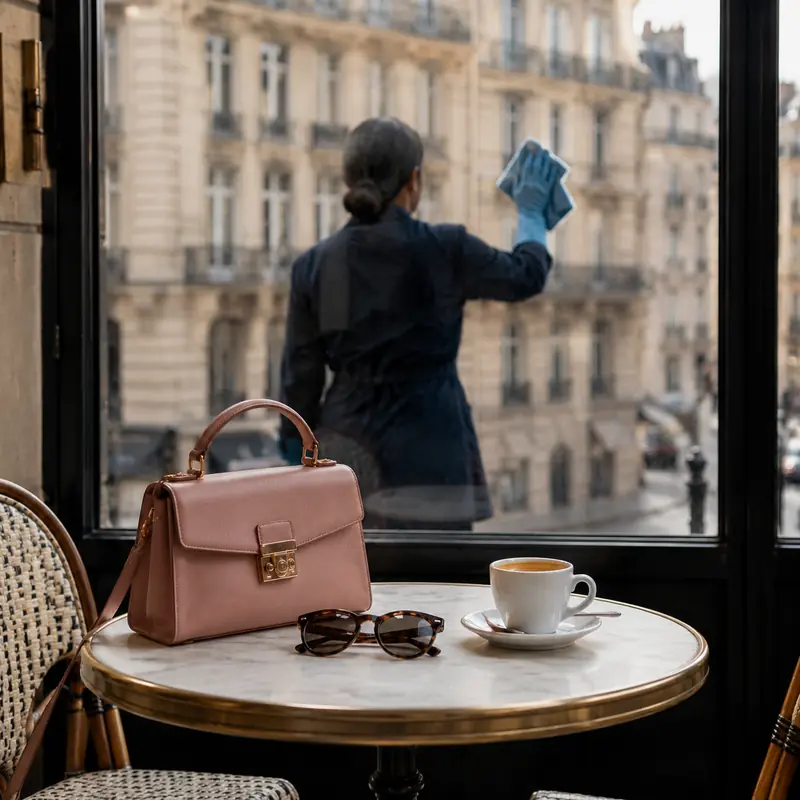
This Paris contains very little of the inequality that structures the actual city. Housing problems, economic hardship, migration, racial segregation, and the pressures of metropolitan work rarely interrupt the postcard. The people who clean, cook, deliver, maintain, and administer the city seldom acquire perspectives of their own.
Emily’s lifestyle follows the same logic. Her wardrobe, leisure, social mobility, and access to luxury are largely detached from a plausible income. Class privilege appears as personality, confidence, and taste rather than as access to money, property, or professional networks. The series does not remove class completely; it translates class into style.
Paris also becomes unusually accessible. Language and bureaucracy occasionally produce comic difficulties, but they rarely create lasting barriers. Most characters can communicate in English, and Emily moves smoothly from the agency to restaurants, fashion events, romantic encounters, and photogenic resolutions. The city seems to be waiting for the right visitor.
Emily’s profession makes this mythology especially visible. She markets luxury goods by turning them into stories for social media. The series performs the same operation on Paris. Emily transforms the city into posts, campaigns, hashtags, and moments of engagement, while the television production transforms it into a continuing object of visual consumption.
The symbolic value of this representation became clear after the fourth season moved part of the story to Rome. French President Emmanuel Macron publicly expressed his desire to keep Emily in Paris, while Rome’s mayor responded that she was welcome in Italy. Their exchange was humorous, but it showed that the series had become part of the international branding of both cities. Paris and Rome were competing not only as filming locations but also as myths offered to global audiences.
Work Without Lasting Consequences
The workplace is another site of mythmaking. The series includes professional conflicts: Emily clashes with her French colleagues, agencies divide and regroup, clients are lost, and careers appear to be threatened. Yet most crises can be resolved through a spontaneous idea, an unexpected connection, or a successful performance.
Creative labor is presented as a world of inspiration, charm, confidence, and self-expression. Hierarchy, routine, exhaustion, and economic insecurity rarely have comparable weight. Competition creates entertaining tension without producing lasting precarity.
Emily’s repeated success also reinforces a familiar cultural contrast. Her American directness and digital enthusiasm initially offend French sensibilities, but they repeatedly solve problems. The series may make fun of her naïveté, yet it also confirms the value of her approach. France provides refinement, tradition, and beauty; American marketing gives these qualities commercial momentum.
Nationality as Stereotype
The series organizes much of its comedy through national stereotypes. Americans appear energetic, optimistic, ambitious, and commercially minded. The French are skeptical, sensual, sophisticated, and resistant to making work the center of life.
Other identities receive similar treatment. Alfie, Emily’s British love interest, initially appears distant, pragmatic, and impatient with Paris. Marcello, introduced in the fourth season, represents an Italian fantasy of family, craftsmanship, village life, sensuality, and authenticity.
These stereotypes make characters easy to recognize. Nationality becomes personality before the individual has been fully developed. Culture functions much like a brand: each nation is given a familiar set of characteristics that distinguishes it from the others.
Romance then arranges these national signs around Emily. Gabriel embodies French charm and culinary artistry, Alfie represents cosmopolitan British distance, and Marcello offers Italian warmth and rootedness. Their relationships appear personal, but they also stage a competition among attractive versions of national identity.
Class differences are displaced in a similar way. Camille comes from a wealthy family associated with a champagne estate. Gabriel is a chef seeking recognition and control of his restaurant. Emily belongs to a world of internationally mobile professionals. These positions could generate a detailed account of money, ownership, and unequal security. Instead, class tension is usually translated into romance, compatibility, and taste.
Diversity Without Social Structure
At first sight, Emily in Paris presents a diverse and international social world. Emily’s closest friend, Mindy Chen, is Chinese; Julien is Black and gay; Alfie is British; Sofia is a Greek artist; and Marcello takes the story into Italy.
These characters expand the series’ visible diversity, but their identities rarely connect to enduring structures of power. Difference tends to function as evidence of a cheerful cosmopolitan world rather than as a perspective from which Parisian inequality can be explored.
Mindy, for example, comes from an extremely wealthy family and lives apart from them after rejecting the future planned for her. When she loses financial security and performs on the street, economic vulnerability becomes a colorful adventure leading to friendship and opportunity. Hardship is transformed into another charming feature of the city.
Race, sexuality, migration, and nationality are included, but class and institutional power remain largely outside the story. This creates a form of diversity without social structure: different identities appear in the frame, yet the conditions that shape their unequal experiences are seldom examined.
Enjoying and Questioning the Myth
The popularity of Emily in Paris should not be explained simply by dismissing its audience or condemning escapism. The series offers beauty, humor, romance, manageable problems, and the repeated promise that disappointment will lead to a new opportunity. In a world marked by uncertainty, this structure has an understandable appeal.
Barthes’s framework does not require us to reject this pleasure. It helps us see how pleasure participates in myth. Viewers may know that Emily’s Paris is unrealistic and still enjoy it. The fantasy is effective because it organizes desire rather than because anyone mistakes it for a documentary.
Seen through Barthes, Emily in Paris turns class into taste, labor into creativity, national history into personality, and urban space into a sequence of desirable images. Moving Emily from Paris to Rome does not necessarily change the formula. It may simply replace one set of myths with another.
The critical task is not to forbid the fantasy or to feel guilty for enjoying it. It is to recognize what the fantasy asks us to forget. The series does not invite audiences to encounter Paris in all its complexity. It invites them to consume “Paris” as a collection of attractive signs from which conflict, labor, and inequality have largely disappeared.
Leave a comment
Comments come straight to me — they aren't posted publicly on the page.