Adaptation note: This essay is adapted from Episode 34 of the author’s Turkish-language CultPost podcast, recorded following the release of the Netflix adaptation in February 2026. It has been translated and edited for international readers while preserving the original argument, theoretical framework, examples, and critical perspective.
Spoiler warning: This essay discusses major events throughout The Museum of Innocence, including its ending.
Turkish Nobel laureate Orhan Pamuk’s The Museum of Innocence (Masumiyet Müzesi in Turkish) occupies an unusual place in contemporary culture because it exists in three distinct forms. It is a novel, first published in Turkish in 2008; a physical museum, opened by Pamuk in Istanbul in 2012; and, since February 2026, a nine-episode Netflix limited series. Directed by Zeynep Günay and adapted for television by Ertan Kurtulan, the series stars Selahattin Paşalı as Kemal and Eylül Lize Kandemir as Füsun.
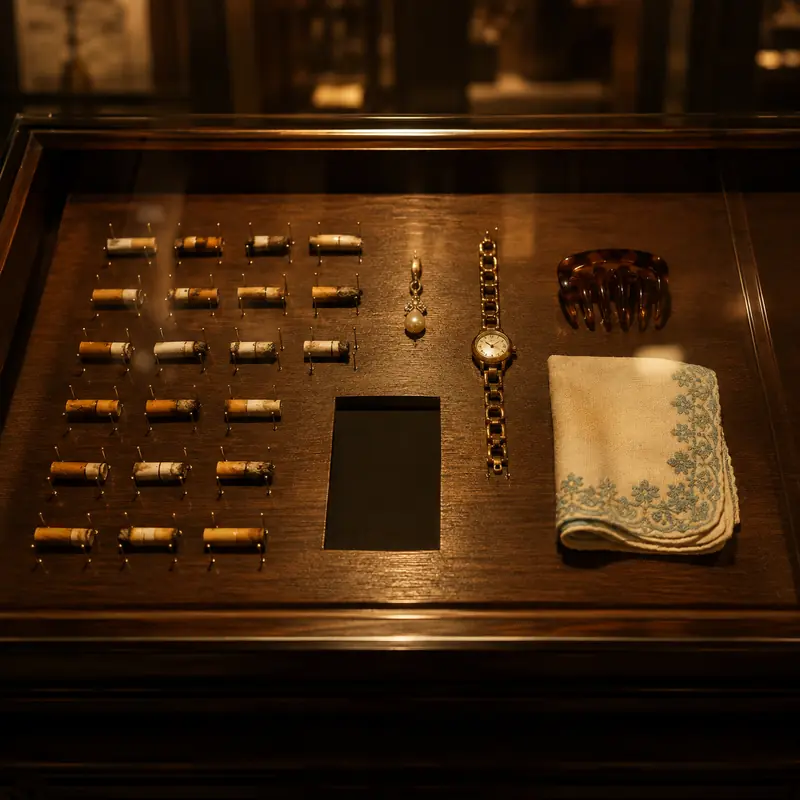
Each version centers on the turbulent relationship between Kemal, the son of a wealthy Istanbul family, and Füsun, his younger and less privileged distant relative. Their story is widely presented as one of impossible love, longing, and obsession. Yet its most distinctive element may be Kemal’s attempt to transform the objects associated with Füsun into a museum. Earrings, hair clips, dresses, cigarette butts, and countless other traces of everyday life become exhibits in an archive that claims to preserve both a woman and a love affair.
This raises a fundamental question: Is the Museum of Innocence a monument to love, or is it a classed and gendered site of domination? Is it an archive that allows Füsun’s life to survive, an incomplete act of testimony, or a space in which representation becomes simulation?
Psychological readings of the story often emphasize Kemal’s obsessive behavior, while feminist readings rightly draw attention to toxic masculinity and the objectification of Füsun. Both approaches are necessary. I want, however, to complicate them by examining the narrative through the concepts of class, cultural capital, curatorial power, archive, and testimony. Pierre Bourdieu and Giorgio Agamben offer the central theoretical points of reference, while Marshall McLuhan and Jean Baudrillard help explain what happens as the story moves from novel to museum and screen.
Three Media, Three Versions of the Story
Marshall McLuhan’s famous proposition that “the medium is the message” offers an important starting point. When the same apparent story is presented through different media, its ontology changes: its mode of existence, sensory effects, and relationship with its audience are transformed. The content may remain recognizable, but a novel, a museum, and a television series cannot produce the same experience.
The novel is governed by language and by Kemal’s retrospective narration. It gives readers prolonged access to his memories, rationalizations, obsessions, and attempts to impose coherence on the past. Its density makes the reader inhabit his consciousness, even when that consciousness is unreliable, self-serving, or oppressive.
The museum operates differently. It removes objects from narrative description and places them before the visitor as material evidence. What the novel asks us to imagine, the museum allows us to encounter spatially and sensorially. The objects appear to confirm that the story happened, even though they belong to fictional characters. The visitor moves physically through a memory structure that has been arranged in advance.
The Netflix series adds bodies, voices, settings, music, costumes, and the visual reconstruction of 1970s and 1980s Istanbul. The novel is richer in interior detail, but the screen adaptation makes class distinction immediately visible. The contrast between Kemal’s affluent world around Nişantaşı and Teşvikiye and Füsun’s lower-middle-class household is communicated through clothing, interiors, manners, speech, and ordinary objects. Viewers do not need to enter the physical museum to see how different forms of capital are inscribed in material culture.
These three media do not simply repeat one story. Each reorganizes it. The novel privileges narration, the museum materializes memory, and the series turns classed habitus into visible performance. Together they form a layered cultural object whose meanings emerge partly from the differences between its forms.
The Museum as a Narrative Machine
A museum is not merely a building in which objects are stored and displayed. It is a mechanism of selection and exclusion, a system for organizing knowledge, and a stage on which a particular version of reality is presented as significant. By removing an object from everyday circulation and placing it behind glass, the museum suspends ordinary time and assigns the object a new status.
The museum says: this matters.
It is therefore never entirely neutral. It selects, classifies, frames, excludes, creates hierarchies, and produces value. Tony Bennett’s The Birth of the Museum situates the modern museum within political technologies that organize both objects and visitors, educating citizens and training the public gaze. Carol Duncan’s Civilizing Rituals treats the public art museum as a ritual setting rather than a neutral shelter for culture. Eilean Hooper-Greenhill’s Museums and the Shaping of Knowledge similarly emphasizes the museum’s role in producing and shaping knowledge.
From these perspectives, the museum becomes a scene of truth. It does not merely preserve evidence of an already established reality; it creates the framework through which that reality will be understood.
Pamuk is clearly conscious of this history and has articulated his own alternative museum philosophy. His official “Modest Manifesto for Museums” rejects monumental institutions organized around nations, states, heroic histories, and collective grandeur. In their place, he advocates smaller and more individual museums devoted to ordinary people, domestic objects, and the depth of everyday life.
The physical Museum of Innocence, located in Istanbul’s Çukurcuma district, embodies this ambition. It is not a national monument. It centers a love affair, two families, and the material culture of ordinary urban life. The museum’s scale is intimate, and its objects are humble rather than heroic.
This is an important intervention in conventional museum culture. Yet smallness does not eliminate power. A museum may be personal, domestic, and opposed to national grandeur while still selecting, classifying, and authorizing a particular narrative. The personal itself has social conditions. It is shaped by class position, gender, access to cultural institutions, and the authority to make one’s memory public.
Curatorial Power and the Institutionalization of Cultural Capital
Within the story, Kemal founds the museum. In the material world, Orhan Pamuk created it. The two figures are not identical, but the overlap is deliberate. The boundaries between author and narrator, fiction and reality, novel and exhibition space become permeable in a characteristically postmodern manner.
The museum’s apparent timelessness is crucial. By removing Füsun’s objects from the changing circumstances of everyday life, it gives Kemal’s arrangement a sense of permanence. The collection does not simply preserve the past; it preserves his interpretation of the past. His class position, aesthetic preferences, and power to represent Füsun acquire an enduring institutional form.
The museum is, in this sense, a narrative machine. Founding it means institutionalizing cultural capital.
Pierre Bourdieu’s concepts of habitus, capital, field, and symbolic power clarify this process. Kemal belongs to the affluent, secular bourgeois world historically associated with Istanbul neighborhoods such as Nişantaşı and Teşvikiye. He possesses substantial economic capital, cultural familiarity, and social connections. These resources allow him not only to collect objects but also to transform a private history into a legitimate public institution.
Füsun is positioned lower within the same broad social field. This is more complicated than a simple opposition between rich and poor. She does not belong to the most marginalized segments of 1970s Istanbul, a period of rapid migration, urbanization, and expanding gecekondu settlements on the city’s outskirts. She and Kemal inhabit overlapping secular and urban worlds, but they occupy unequal positions within them. Her family has less economic security, fewer influential connections, and more limited access to the cultural legitimacy that Kemal takes for granted.
Kemal’s museum is therefore an exercise in curatorial power. Curating means deciding what will be shown, which context will govern its interpretation, which objects deserve preservation, and which story the visitor will encounter. Curatorial authority is also symbolic authority: the power to name, assign meaning, and establish the legitimate interpretation of a life.
Kemal names Füsun’s experience.
He frames her through “innocence.”
He decides which of her memories matter.
He writes history on her behalf.
This is more than a romantic gesture. It is a monopoly over meaning.
Füsun’s discarded objects are selected, classified, and placed inside display cases, but she does not choose the objects or control their interpretation. Kemal converts her from a living and contradictory person into an aesthetic object organized around his longing. He uses his grief to secure a position within the cultural field, canonizes his private story, and gives personal suffering public legitimacy.
Private pain becomes public cultural capital.
The process is also gendered. The man narrates; the woman is exhibited. The man institutionalizes; the woman is remembered through objects. The man writes history; the woman becomes its material.
The museum is therefore not only a place of love. It is also a place of possession.
Archive, Voice, and the Limits of Testimony
This curatorial structure leads directly to the politics of the archive. An archive does not merely retain what already exists. It orders, classifies, and selects. It determines which traces will survive and which stories will be available to the future. Every archive is therefore also a structure of power.
Kemal does more than preserve a love affair. He archives another person’s life. Yet the person being archived and the person building the archive are not the same. Kemal selects, names, frames, and interprets Füsun’s objects. The archive belongs to him even when its declared subject is her.
Füsun is not literally silent. She speaks, desires, resists, and makes decisions within the story. The more precise problem is that she does not author the archive that claims to preserve her. We do not receive an independent museum organized by Füsun or an equivalent narrative governed by her interior voice. Her presence reaches us through Kemal’s retrospective account and through the objects to which he assigns meaning.
Can testimony remain testimony when it is constructed in another person’s voice? Or does it become representation—and then a representation legitimized by the authority of the archive?
Giorgio Agamben’s Remnants of Auschwitz: The Witness and the Archive offers a difficult but useful insight into this problem. Agamben’s argument arises from Holocaust testimony and must not be casually detached from that history. Füsun’s experience is not comparable to the experiences around which his analysis is built, and she should not be assimilated to his concept of “bare life.” I borrow only a structural insight: testimony contains a constitutive gap because the person who can speak is not always identical with the person whose experience most urgently requires testimony.
In The Museum of Innocence, Füsun’s life appears to speak through the archive, but the voice is indirect, inherited, and framed. Kemal’s museum promises presence while revealing absence. It preserves her material traces, yet it cannot give us Füsun outside his desire.
This produces what might be called impossible testimony. The testimony is not nonexistent, but it cannot be complete. Füsun remains visible only through a structure that also appropriates her.
Kemal as an Ethnographer of Another Class
Kemal’s long years of visiting Füsun’s family home make the class structure of this testimony even clearer. His movement into their domestic world can appear to be a downward movement from his own class position. He leaves behind the comfort and prestige of his bourgeois milieu and spends evening after evening in a less privileged household.
Yet this descent does not produce equality. Kemal does not merely inhabit the house; he observes it. He records details, stores memories, removes objects, and gradually converts the family’s everyday life into material for a future collection. He behaves, in this sense, like an ethnographer.
Ethnography can generate profound forms of understanding, but historically it has also involved unequal relations between the observer and the observed. The person with institutional authority enters another group’s world, produces knowledge about it, and later circulates that knowledge within institutions unavailable to the people being represented.
Kemal’s position is comparable. His economic, cultural, and social capital allows his observations to become an archive. Füsun has no equivalent institutional route through which to transform her experiences into one. In Catherine Hakim’s controversial terminology, her most socially visible resource is erotic capital—beauty, attractiveness, and desirability. Yet erotic capital cannot be institutionalized in the way Kemal’s resources can. It does not found a museum, authorize an archive, or secure control over historical meaning.
Kemal’s observations become documents.
Füsun’s life becomes evidence.
The story, however, remains his.
Agamben’s gap within testimony and Bourdieu’s account of symbolic power thus converge. The incompleteness of the archive is not accidental. It is classed and gendered. The person with the capacity to archive monopolizes the power to speak, while the person being memorialized survives within a language she did not control.
Domination Does Not Make the Archive Meaningless
This critique requires an important qualification. Kemal’s museum is dominating and incomplete, but it is not therefore nothing. Its inability to transmit Füsun’s unmediated voice does not mean that no trace of her remains or that the archive has no testimonial value.
Pamuk appears conscious of this contradiction. The Museum of Innocence does not resemble a conventional state museum that confidently presents its account as objective truth. It draws attention to collecting, obsession, selection, and the instability of memory. The story makes the partiality of Kemal’s testimony visible even as it allows him to construct the museum.
The archive may appropriate Füsun, but it also prevents her complete disappearance. Objects give her a form of presence, however mediated. A hair clip, dress, or cigarette butt cannot speak independently, yet it can resist total erasure by preserving a material trace of an existence that the dominant social world might otherwise forget.
The ethical question is therefore not whether the archive is pure. No archive is. The question is whether an incomplete and compromised testimony can still carry meaning. In this case, I think it can. The museum’s value lies partly in its contradiction: it simultaneously preserves Füsun and reveals the impossibility of fully representing her.
Class Exile and the Impossibility of Love
Kemal’s authority does not leave him untouched. His devotion to Füsun gradually produces his own exclusion from the bourgeois world to which he belongs. In the series’ Milan sequence, Sibel and one of Kemal’s former close friends see him and then move away. Their reaction condenses a longer process of social rejection. Within the value system of his class, Kemal’s attachment has made him embarrassing and illegible.
In a broadly Lacanian formulation, the social codes that once secured Kemal’s place in the symbolic order no longer recognize him as a proper member of that world. In Bourdieusian terms, he has become an undesirable figure within his own habitus and social field. His obsessive collecting and fetishization of Füsun are connected not only to private psychology but also to this ideological displacement.
His exclusion nevertheless remains different from Füsun’s structural disadvantage. Kemal retains economic capital. He survives comfortably, travels, collects, and ultimately founds a museum. Even when his class rejects him socially, its resources continue to protect him materially. Füsun has no equivalent protection.
The narrative repeatedly turns unequal mobility into a barrier between them. Their imagined journey to Paris never becomes the shared escape it promises to be. Füsun encounters difficulty obtaining a passport. Her uncertain relationship with driving becomes another sign of restricted mobility, and the car that might have carried the couple toward a different future instead becomes the instrument of her death.
These are not merely unfortunate plot events separating two lovers. They materialize the symbolic and class barriers that prevent Kemal and Füsun from becoming equal partners. Kemal attempts to resist his class world, but he cannot escape the hierarchy that structures their relationship. His efforts to possess and preserve Füsun ultimately reproduce the same inequality he imagines love can transcend.
This is why reducing the story either to anti-feminism or to Kemal’s obsessive personality remains insufficient. Both are present, but the relationship is also organized by social space. Popular culture frequently allows a rich woman and a poor man—or a wealthy man and a poor woman—to unite without sustaining serious class conflict. The Museum of Innocenceis powerful because it is built around the failure of that fantasy.
Love is itself a classed phenomenon. There is no wholly romantic, socially weightless form of love.
From Literary Work to Popular-Cultural Event
The Netflix adaptation has carried the narrative into a much broader sphere of circulation. Following the series’ release, the novel returned visibly to bookshop displays and public discussion, the museum attracted renewed attention, and Kemal and Füsun’s relationship became a recurring subject across social media. This renewed visibility is significant, even if some copies of the book are purchased as markers of taste or used decoratively rather than read in full. A literary work entering everyday cultural circulation is not in itself a loss.
The change of medium nevertheless changes the story. Pamuk’s influence over the adaptation remains conspicuous, and the series treats the objects, interiors, and differences of habitus with considerable care. Its visual design makes class distinction accessible and effective. At the same time, incorporation into Netflix’s global popular culture encourages the narrative to be consumed primarily as an impossible love story.
The visual medium also intensifies the question of gendered looking. Füsun’s beauty and body can become a focal point for a heterosexual male spectator, extending the male-centered structure already present in Kemal’s narration. She risks becoming not only the object of Kemal’s desire but also a promotional and visual attraction within popular culture—a phallocentric center of longing.
This does not cancel the series’ achievements. It demonstrates McLuhan’s point: a screen adaptation cannot merely deliver the novel’s content unchanged. The series makes classed material culture more visible, but it can also make the romance and the female body more immediately consumable. The medium reorganizes both the critical possibilities and the ideological risks of the narrative.
The Museum as Simulacrum
Jean Baudrillard’s concept of the simulacrum provides the final layer of this analysis. A simulacrum is not simply a false copy of an authentic original. It is a representation that destabilizes the distinction between original and copy, sometimes producing a reality that appears more complete or convincing than what supposedly preceded it.
The Museum of Innocence is a remarkable simulacrum because it offers material evidence of fictional lives. The museum’s visitors encounter objects presented as though Kemal and Füsun had used, worn, seen, and collected them. Yet these characters did not exist outside the novel. The archive is materially real, while the life it documents is fictional.
This does not make the museum fraudulent. Its power comes from the confusion it creates between fiction, memory, and evidence. Pamuk conceived the novel and museum together, gathering objects while constructing the story. The novel seems to generate the museum, while the physical museum retrospectively makes the novel appear documented. Each medium verifies the other within a circular structure.
The Netflix adaptation adds a further level. Actors give bodies and voices to the fictional characters; reconstructed spaces make their Istanbul visible; the museum then appears to preserve objects belonging to those represented lives. Novel, museum, and series form a system in which no single version functions as an uncomplicated original.
This is the narrative’s most original achievement. A literary fiction becomes an archive, the archive acquires the authority of testimony, and the screen adaptation circulates both as popular memory. The result is a hyperreal field in which visitors and viewers may encounter Kemal and Füsun not merely as characters, but as figures whose past appears materially recoverable.
Love, Possession, and the Politics of Remembering
The Museum of Innocence cannot be reduced to a monument to romantic devotion. It is also a study of who has the resources to collect, who has the authority to interpret, and whose version of the past becomes permanent. Kemal’s museum preserves Füsun while transforming her into an object. It testifies to her life while monopolizing the terms of that testimony. It challenges the grand national museum while retaining the symbolic power of curation.
Its significance lies precisely in these contradictions. Kemal’s archive is classed, gendered, appropriative, and incomplete. Yet the objects still bear traces; the testimony still carries meaning; and Füsun is not entirely erased. The museum neither restores her voice nor leaves us with pure silence.
Across novel, museum, and television, the story demonstrates that memory is never innocent. Every act of preservation is also an act of framing. Every testimony contains a gap. Every archive reflects unequal capacities to make a life public. And every love unfolds within social structures that shape whose desires can be realized, whose mobility is restricted, and whose suffering can be converted into culture.
The Museum of Innocence is therefore both an archive of love and an institution of possession. Its enduring power comes not from resolving that tension, but from making it impossible to ignore.
Leave a comment
Comments come straight to me — they aren't posted publicly on the page.