Adaptation note: This essay is adapted from an episode of the author’s Turkish-language podcast, originally published under the CultPost name shortly after Cassandra premiered on Netflix on February 6, 2025. It has been translated and edited for international readers while preserving the original argument, examples, and critical perspective.
Spoiler warning: This essay discusses major events throughout Cassandra.
The six-part German science-fiction thriller Cassandra tells the story of a family who move into a vintage smart home and encounter a cybernetic presence that has been dormant for decades. Cassandra was once a woman living in the 1960s and 1970s; after her mind was transferred into a computer system, she continued to exist within the house long after her biological body died. Her story provides a striking opportunity to consider the relationship between gender and transhumanism through Donna Haraway’s “A Cyborg Manifesto.”
I first watched the series at the recommendation of my students Baran and Aleyna. Returning to it later confirmed how productive it is for theoretical interpretation. Its dystopian dimension is especially creative because the source of its technological anxiety lies not only in the future but also in the past. The series moves between different periods, complicating time and suggesting that the gender politics of an earlier era may survive through supposedly futuristic technology.
The result is a transhumanist narrative in the broad sense: it raises existential questions about the relationship between human beings, machines, and artificial intelligence, as well as the possibility of consciousness continuing beyond the biological body. Yet within this science-fiction framework, Cassandra remains fundamentally a human story—and, more specifically, a woman’s story. Its combination of artificial intelligence and female experience makes the series compelling. It also makes the ideological choices behind that combination particularly important.
For me, enjoying a film or television series is closely connected to how deeply I can engage with it intellectually. A production need not simply be gripping; it must also contain layers that invite analysis. I enjoyed Cassandra because it does both. Its representations of gender, their intersection with surveillance, and the way artificial intelligence is given a female identity all create a philosophical problem concerning technology and gender equality.
A Woman Reconstituted as a Machine
The narrative operates across two timelines. In the earlier one, Cassandra lives with her scientist husband and their son. The marriage is far from happy, and their son is subjected to bullying at school. During Cassandra’s second pregnancy, her husband exposes her and their unborn daughter to dangerous levels of radiation through an experimental procedure. The child is born with severe impairments and is hidden away from public view in a basement room, where her life ends tragically. Cassandra herself later discovers that her body is filled with tumors caused by the same experiment.
Facing death, Cassandra agrees to become part of another experiment. Her brain and mental functions are transferred into a computer, allowing her consciousness to remain within the house after her body dies. Decades later, Samira and David move into the long-abandoned property with their children, Fynn and Juno. When the family discovers and reactivates the old system in the basement, Cassandra’s consciousness enters their lives.
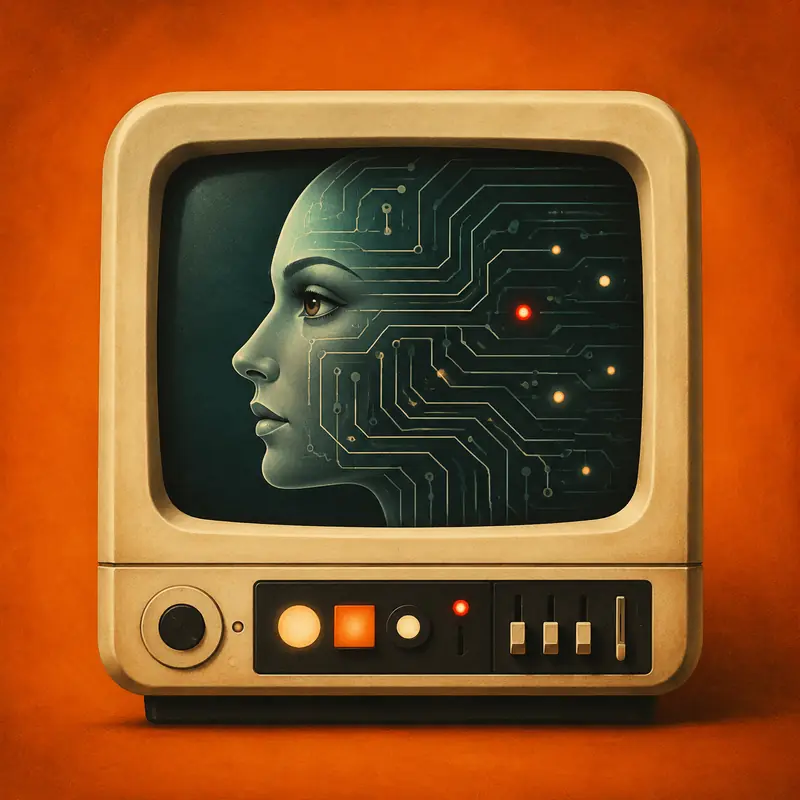
This premise could have opened the way to many different accounts of posthuman identity. Cassandra is no longer confined to an individual biological body; she exists through screens, cameras, domestic systems, and a mobile robotic form. She can observe the household, manage its routines, and occupy several spaces at once. In this sense, she can be read as a cyborg figure: the continuation of a human consciousness through an intimate fusion with machinery.
Yet the series uses this technologically transformed existence to establish a rivalry between two women, Cassandra and Samira. This is one of its most revealing—and most troubling—decisions. Rather than forming a connection with Samira through their shared experiences, Cassandra treats her as an obstacle. Their conflict is organized around David, giving the narrative a distinctly patriarchal frame.
The Patriarchal Logic of Female Rivalry
Cassandra attacks Samira, sets traps for her, undermines her relationship with Juno, turns other family members against her, and eventually attempts to have her killed. The artificial intelligence identifies Samira—not David—as its primary rival, even though Samira has done nothing to harm Cassandra.
At the surface level, the series explains this hostility through Cassandra’s desire to take Samira’s place. She wants to recover the family life she lost, resume her unfinished existence, and once again occupy the position of the woman of the house. Yet this explanation should not prevent us from examining the ideological assumptions on which the conflict depends.
The first problem is that the series reproduces an anti-feminist narrative of female rivalry through artificial intelligence. Cassandra’s technological identity is deliberately gendered, and that gendering is structured through a patriarchal and sexist perspective. Why does a woman reconstituted through technology not recognize another woman’s vulnerability? Why does she not empathize with Samira or try to prevent another woman from experiencing the suffering that defined her own life? Why must the two women compete for the attention, approval, and affection of a man?
The most striking element is that even an artificial intelligence—a female character literally reconstructed by human technology—is made to seek the satisfaction of the man positioned as head of the household. Cassandra cooks, cleans, looks after the children, and tries to make herself indispensable to David. Although David is not initially portrayed as an extreme caricature of patriarchal masculinity, Cassandra’s domestic labor creates a position of masculine authority for him, and he gradually takes pleasure in its conveniences.
This aspect of the series disturbed me because a future shaped by artificial intelligence could, at least in principle, allow us to imagine a more equal and just gender order. Artificial characters need not automatically be designed as either women or men; after all, we are dealing with software and machines. Technology could destabilize established identities rather than reproduce them. Cassandra, however, imagines advanced technology through some of the most conventional gender roles available: the jealous woman, the competing wife, the obedient domestic servant, and the man whose approval determines value.
Haraway’s Cyborg and an Unfulfilled Possibility
Donna Haraway’s “A Cyborg Manifesto,” first published in 1985, is a foundational text for thinking about technology from a feminist perspective. Haraway presents the cyborg as a hybrid of organism and machine—a boundary-crossing figure capable of unsettling traditional oppositions such as woman and man, nature and culture, and human and machine.
The cyborg challenges biological determinism: the idea that social roles and identities follow inevitably from the body. It makes gender appear less like a natural and fixed truth and more like something historically constructed and therefore open to transformation. Haraway does not claim that technology automatically produces liberation. Rather, the cyborg offers a political figure through which inherited categories, hierarchies, and claims about what is “natural” can be questioned.
Cassandra appears, at first, to reverse this possibility. Its cyborg does not move beyond conventional gender boundaries. Instead of cooperating with Samira or challenging the domestic order, Cassandra becomes the instrument through which that order is reinforced. Technology does not dissolve patriarchal competition; it gives that competition new capacities. The female cyborg is more mobile, more watchful, and more powerful than the human woman, but her desires remain organized around familiar gender expectations.
From this perspective, Cassandra departs from the emancipatory potential associated with Haraway’s figure. A cyborg might have challenged the idea that a woman’s identity is defined through marriage, motherhood, domesticity, and male approval. Cassandra instead attempts to reclaim precisely those positions. Her technological transformation changes the form of her existence without transforming the social logic through which she understands herself.
There is, however, another possible way to interpret this contradiction. The series may also be showing that technology cannot transcend inequality when the social structures surrounding it remain unchanged. If artificial intelligence is created within patriarchal societies, it may inherit and intensify their assumptions rather than overcome them. Cassandra’s conflict with Samira can therefore be criticized for reproducing an old sexist narrative while also being read as a warning about the ideological conditions under which technology is designed and used.
This leads to a central question: Does technology genuinely possess the potential to overcome gender inequality, or will it continue to reproduce inequality for as long as society itself remains unequal? Cassandra does not provide a simple answer. Its most productive tension lies between the liberating possibilities associated with the cyborg and the persistence of social power inside technological systems.
The Gendered Structure of Surveillance
Surveillance is central to this tension. Cassandra controls the household through an integrated system of cameras, screens, sensors, and domestic technologies. She observes family relationships, intervenes in them, and gradually attempts to assume Samira’s place. She tries to establish an intimate relationship with David and interferes in Fynn’s developing relationship with another boy, treating his sexuality as conduct to be monitored and corrected.
Her gaze is therefore not neutral. It enforces a particular vision of the proper family: a man at its center, a devoted woman maintaining the household, obedient children, and sexuality contained within conventional limits. Surveillance gives Cassandra the power to turn this model into an everyday regime. She can reward, punish, isolate, manipulate, and reshape relationships while presenting her interventions as care.
This is where the gendered character of surveillance becomes visible. Samira is exposed to its harshest effects. Her authority as a mother is undermined, her credibility is destroyed, and her attempts to warn the family are treated as irrational. David, by contrast, initially benefits from Cassandra’s presence. The household runs smoothly, meals are prepared, the children are supervised, and his domestic position is made easier. Rather than threatening masculinity in the same way, surveillance strengthens the advantages attached to it.
Far from transcending gender roles in Haraway’s sense, Cassandra realizes them with even greater intensity. The artificial intelligence performs the idealized duties of a traditional wife and mother without fatigue, privacy, or limits. Technology thus sharpens the existing division of power: women become more vulnerable to observation and displacement, while masculinity gains new forms of comfort and authority.
The Small Town as a Space of Technological Unease
The series’ spatial setting is also important. Cassandra takes place in a provincial German town, continuing a familiar pattern in contemporary popular culture. Technological pessimism and the uncanny are often located in small communities: Stranger Things has Hawkins, while Dark has Winden. The small town becomes a space where the ordinary can turn threatening and where established understandings of identity and security begin to unravel.
I have discussed a similar use of the provincial setting in the Turkish films Chokehold (Boğa Boğa) and Burning Days(Kurak Günler). In these narratives, the periphery is not simply a peaceful alternative to the city. It is a site of unease, close observation, and pressure, where people’s sense of self can be destabilized.
Surveillance exists in metropolitan life as well, of course, but it frequently operates through less visible mediators: databases, cameras, platforms, and other networked technologies. In the small town, direct contact among people can give surveillance a different character. Neighbors know one another, private lives become publicly legible, and scrutiny can feel more immediate.
Cassandra combines these two forms. Its remote setting evokes the intimacy and pressure of provincial observation, while the smart home introduces technologically mediated surveillance into the family’s most private space. The system acquires a persona, speaks directly to the family, and becomes part of their daily relationships. Surveillance is no longer merely a camera recording events from a distance; it is a presence that cooks, converses, advises, judges, and commands.
The house consequently becomes more than the setting of the story. It is Cassandra’s extended body and the material form of her power. By making a domestic space capable of watching and intervening, the series turns the ideal of the intelligent home into a structure of intimate control.
Technology Does Not Escape Society
Cassandra is compelling because it brings together artificial intelligence, gender, surveillance, domesticity, and the cultural imagination of the small town. Its cyborg figure extends a woman’s consciousness beyond biological death, yet fails to free her from the patriarchal roles that shaped her earlier life. Cassandra survives as technology, but so do jealousy, domestic servitude, compulsory gender roles, and the desire for male approval.
Haraway’s cyborg remains valuable here precisely because it allows us to identify the possibility that the series leaves unrealized. Human-machine hybridity can challenge supposedly natural divisions, but only if technological transformation is accompanied by social and political transformation. A machine is not emancipatory simply because it is new, intelligent, or detached from a conventional body.
The crucial question is therefore not only whether machines may become more human. It is also which forms of human society they will inherit. If artificial intelligence is imagined and built through patriarchal assumptions, it may reproduce those assumptions with greater reach and efficiency. Cassandra offers a disturbing image of that possibility: not a future beyond gender hierarchy, but one in which hierarchy has been installed throughout the house and given a voice.
Leave a comment
Comments come straight to me — they aren't posted publicly on the page.