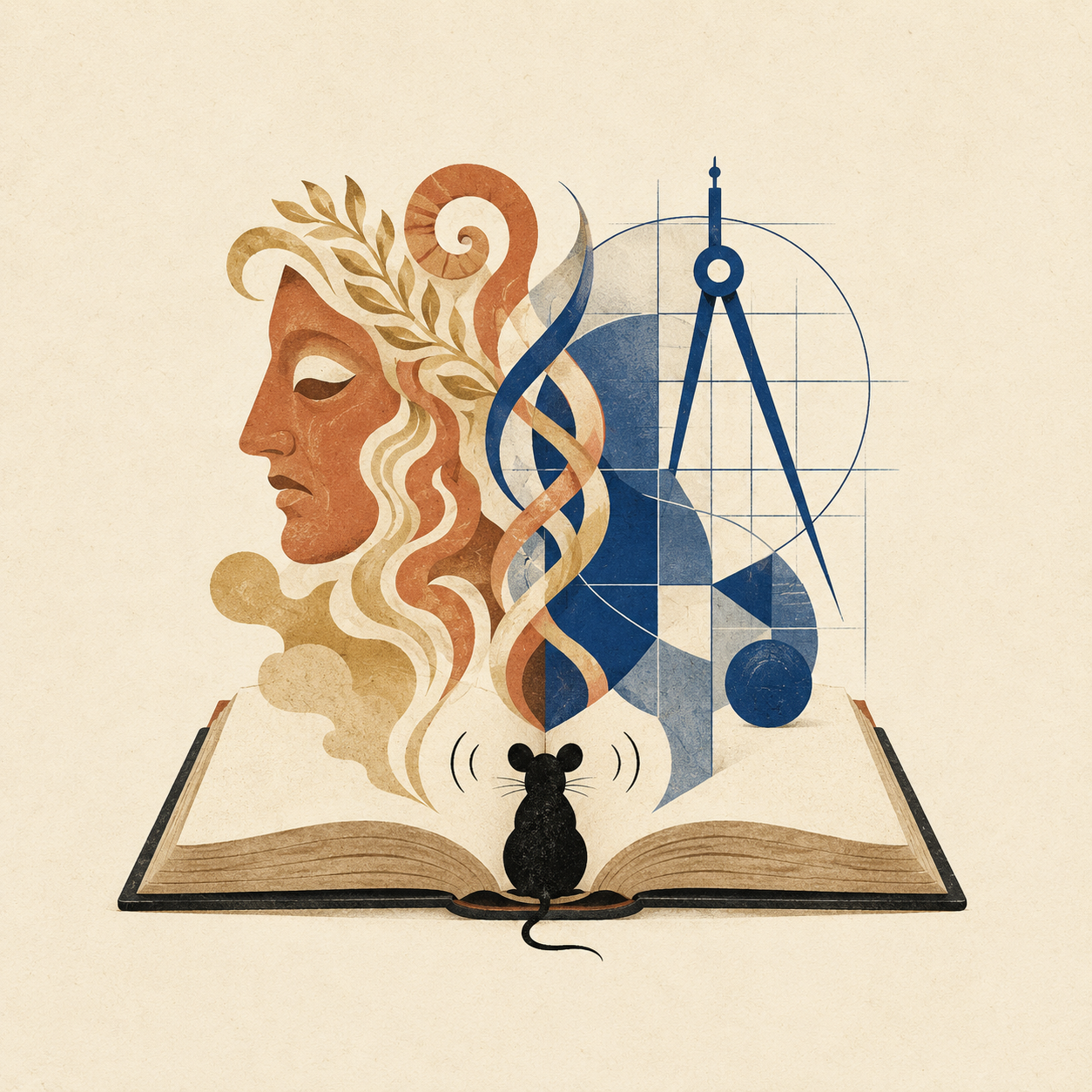
Giambattista Vico’s New Science belongs to the eighteenth century, yet many of its central concerns resonate with debates that became prominent in twentieth-century philosophy and literary theory. Vico’s challenge to the rigid opposition between myth and reason anticipates later critiques of Enlightenment rationality. His understanding of mythology as a form of fiction that nevertheless communicates social truth also invites comparison with the work of Mikhail Bakhtin and Franz Kafka.
This essay first considers Vico alongside Theodor W. Adorno and Max Horkheimer, focusing on their respective accounts of mythology and Enlightenment. It then examines how Vico’s refusal of binary oppositions anticipates a deconstructive mode of thought. Finally, through Kafka’s “Josephine the Singer, or the Mouse Folk” and Bakhtin’s theory of heteroglossia, it explores the relationship between fiction, collective experience, and social reality.
Vico, Adorno, and Horkheimer: Mythology and Enlightenment
In The Rehabilitation of Myth: Vico’s New Science, Joseph Mali explains that Enlightenment thinkers frequently defined the mythical as “savage and ancient,” excluding it from cultural systems understood as “civil and modern.” Within this framework, reason and rationality represented progress, while mythology appeared false, irrational, or unreal.
Vico challenges this opposition. He approaches mythology as a “true narration”: a distinctive mode of expression with its own forms, history, and logic. Myth does not arise simply from irrational or absurd behaviour. It offers an alternative way of perceiving and organizing reality. Mythological thought therefore possesses a form of rationality, even if that rationality differs from the empirical and scientific models privileged by the Enlightenment.
A related critique appears in Adorno and Horkheimer’s Dialectic of Enlightenment. Like Vico, they question the assumption that Enlightenment represents the final and highest stage of human development. Enlightenment seeks to demythologize and disenchant the world by eliminating uncertainty. It attempts to liberate humanity from fear by making nature calculable and knowable.
In this process, however, the living world is increasingly translated into numbers, chemical components, physical laws, and measurable mechanisms. Spirits and gods disappear, but they are replaced by systems of classification and calculation. Anything that cannot be measured risks being treated as if it does not exist.
Adorno and Horkheimer consequently argue that mythology and Enlightenment are not simply opposites. Myth already contains an effort to explain and control the unknown, while Enlightenment carries that effort to an extreme. Their famous formulation—“myth is already enlightenment, and enlightenment reverts to mythology”—captures this reversible relationship.
Enlightenment does not necessarily liberate humanity from mythology and fear. Instead, its demand for total knowledge can become mythological in its own right. It transforms rationality into an absolute authority, reproducing the very structures it claims to have overcome.
This dialectic is already implicit in Vico’s New Science. Mythology does not disappear with the emergence of modern rationality. It remains immanent in human societies and continues to shape how communities understand themselves.
A tentative Lacanian analogy can be drawn here. Myth may be compared to the imaginary: something supposedly surpassed by the symbolic structures of modern society but never entirely eliminated. Modern rationality occupies the position of the symbolic order, yet mythic images, desires, and identifications continue to return within it. The age of mythology may appear historically distant, but mythology remains embedded in social life.
Vico before Deconstruction
Vico refuses to understand history as a linear movement from mythos to logos. Mythological and rational thought are, for him, different but equally significant ways through which human beings have attempted to make sense of reality. One works through imaginative narratives projected onto the world; the other produces empirical theories derived from it.
His interpretation of Homer offers a particularly striking example. Traditional accounts tended to portray Homer either as a primitive poet or as a sublime literary figure. Vico does not accept this opposition. Homer’s primitiveness and sublimity are not contradictory qualities. His poetry is sublime precisely because it emerges from the collective and supposedly primitive conditions of mythological culture.
It would be historically anachronistic to call Vico a deconstructionist. Nevertheless, his method anticipates a central deconstructive gesture: the questioning of binary oppositions in which one term is privileged over another. Vico does not merely reverse the hierarchy between the primitive and the civilized or between myth and reason. Instead, he demonstrates that the two sides depend upon one another.
His significance therefore lies in his effort to think beyond the dualities established by Western philosophy. Myth and reason, primitiveness and sublimity, fiction and truth cannot be neatly separated. Each term carries traces of the other.
Vico and Kafka’s “Josephine”: Is Josephine Another Homer?
Vico’s understanding of the sublimity of the primitive also recalls Franz Kafka’s “Josephine the Singer, or the Mouse Folk.” Kafka’s story is narrated by a member of a community of mice who reflects on the peculiar influence of Josephine, their celebrated singer.
Josephine’s singing does not appear technically original. It may consist of little more than the ordinary piping used by the mouse folk in everyday life. Nevertheless, when Josephine performs, the community listens with admiration. Her art transforms an ordinary and collective form of expression into something that appears exceptional.
Josephine’s art is primitive, yet it is also sublime. In this respect, her position resembles Vico’s account of Homer. Homeric poetry emerged from the collective images and experiences of ancient Greek society. Similarly, Josephine’s singing consists of sounds already embedded in the everyday life of her community.
Her originality does not lie in creating an entirely new language. It lies in making the community hear its own language differently. Through performance, Josephine turns ordinary piping into an aesthetic event.
This comparison also illuminates Vico’s account of mythology as fiction and, at the same time, true narration. Myth is fictional because it does not provide an immediate or documentary record of historical events. Its truth lies instead in the way it narrates social reality.
Josephine’s performance can be understood in similar terms. Her song is a fiction in the sense that it transforms ordinary piping into an elevated aesthetic form. Yet it also tells the truth about the mouse folk because it emerges from one of their most basic forms of communication. Her art enables the community to recognize something about itself.
Neither Homeric poetry nor Josephine’s singing belongs exclusively to an isolated individual. Both condense forms of expression already circulating within a community. Their art is therefore collective as well as individual, ordinary as well as sublime.
Vico and Bakhtin: Fiction, True Narration, and Collectivity
The relationship between fiction and collective reality later became central to the work of Russian philosopher and literary theorist Mikhail Bakhtin. His theory of the novel is based on the concept of heteroglossia: the coexistence of multiple social voices, languages, accents, and ideological positions within discourse.
For Bakhtin, the novelist does not purify language of the intentions of others. The novelist works with words that have already been used, valued, and shaped by different social groups. These words are redirected toward new purposes, but they never become entirely private. As Bakhtin memorably observes, “the word in language is half someone else’s.”
The novel is fictional, yet it remains filled with collective realities and individual subjectivities. Its language carries social histories, ideological conflicts, and the intentions of others. Fiction cannot therefore be separated from the political and cultural conditions within which language circulates.
A similar argument can be found in Vico’s treatment of poetry and mythology. As Mali emphasizes, Vico understands poetry in sociopolitical rather than purely aesthetic terms. Mythological tales respond to the shared needs, institutions, and practices of civil life. They are imaginative constructions, but they emerge from collective existence.
This is where Vico and Bakhtin meet. Both reject the idea that fiction is detached from reality. Fiction is produced through socially inhabited forms of language and narration. Its truth does not depend upon its ability to reproduce reality as a neutral record. Instead, fiction becomes true by giving narrative form to the experiences, conflicts, and shared meanings of a community.
Conclusion
Vico’s importance for twentieth-century thought lies in his refusal of stable separations: between myth and reason, fiction and truth, the primitive and the modern, or individual creativity and collective language. Adorno and Horkheimer reveal how Enlightenment can return to mythology. Kafka’s Josephine transforms the ordinary sounds of her community into art. Bakhtin shows that even the most individual utterance remains populated by the voices of others.
Vico does not belong directly to each of these intellectual traditions. Yet The New Science provides a conceptual framework through which their shared concerns become visible. Its continuing relevance lies in the recognition that humanity often tells the truth through the very forms—myth, fiction, poetry, and collective narration—that rationalist thought once attempted to dismiss as mere fables.
Works Cited
Adorno, Theodor W., and Max Horkheimer. Dialectic of Enlightenment: Philosophical Fragments. Edited by Gunzelin Schmid Noerr, translated by Edmund Jephcott, Stanford University Press, 2002.
Bakhtin, M. M. The Dialogic Imagination: Four Essays. Edited by Michael Holquist, translated by Caryl Emerson and Michael Holquist, University of Texas Press, 1981.
Kafka, Franz. “Josephine the Singer, or the Mouse Folk.” The Complete Stories, edited by Nahum N. Glatzer, Schocken Books, 1971.
Mali, Joseph. The Rehabilitation of Myth: Vico’s “New Science”. Cambridge University Press, 1992.
Vico, Giambattista. The New Science of Giambattista Vico. Translated by Thomas Goddard Bergin and Max Harold Fisch, Cornell University Press, 1984.
Leave a comment
Comments come straight to me — they aren't posted publicly on the page.